Saturday, April 13, 2013

Droning On and On...


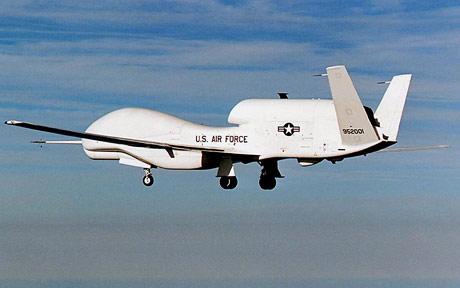
“If we are not willing to commit blood to the cause, we should take an appetite suppressant for our drone use.” This quote, by West Point professor Ike Wilson, generally sums up the panel’s feeling on drone warfare during the Conference on World Affairs talk: “Droning On and On: New Conventional Warfare.”

Professor Wilson brought up three points to explain why he has an issue with drone strikes.  They are as follows:

1.     Legality.  Mr. Wilson took issue with the legality of drone strikes from a due process standpoint, (both domestically and internationally), as well as a violation of sovereign airspace. 
2.     Military sales.  Because of the cheap cost of drones, ease of purchase, and high return on investment, the US will eventually be surpassed in drone technology.  This means that adversarial states will have the ability to potentially use drones against the United States
3.     War theory dimension.  Drones further blur the line between combatant and noncombatant, executive vs. legislative control, and belligerent vs. non belligerent acts of war.  The president is able to authorize the use of drones by executive order, giving him emense power to carry out drone strikes without the public being aware.  Often times, these drone strikes are targeting “militants” who actually just may be ordinary citizens. 

Most importantly for Professor Wilson, drones dehumanize warfare, leading to an “easy war” solution.  If we aren’t willing to send soldiers a country for war, is the cause really worth it?  According to Wilson, “War should never be easy, especially for democracies.”

Dr. John Tirman, a professor at MIT, took similar issues with drones.  Mr. Tirman spoke on defense, pointing out the idea that with the introduction of any military weapon, adversaries eventually gain the same capability.  This is the case with chemical weapons, missiles, and, of course, nuclear weapons.  It is simply a matter of time until the US sees adversarial threats for drone use against the America. 

Though Dr. Tirman described himself as a “general supporter” of President Obama, the use of drones is an impeachable offense, according to him.  Drone use, he says, is not out of bounds itself, but the denial of use, collateral damage, violation of sovereignty, and conduction of wars in places where war has not been declared is down right illegal. 

What’s more, is the high rate of suicide among drone operators. One reason for this, Mr. Tirman hypothesized, is that a drone operator does not see the same culture of support from his or her unit, as they might during a boots on the ground operation.  The environments, without a doubt, are psychologically different. 

Other speakers discussed major problems with civilian casualties as a result of drone use.  Not only are civilians accidently labeled “enemy militants” and killed by drone strikes, they are also killed when they act as first responders to a drone strike—running to the scene of an initial drone strike in order to help, only to be injured or killed by a second drone strike.  And do these civilians receive any compensation for an injury or death of a loved one? Often times not. 

This panel raised some very real and concerning issues with the use of drones.  In fact, it has made me rethink my stance on drones.  I particularly take issue with the lack of transparency regarding President Obama’s authorization of drone strikes.  The unauthorized use of drones demonstrates not only a major transparency issue within our government, but allows our executive to carry out wars without public knowledge.  This I have a major problem with.

Though I am not discourage drone use completely, I absolutely do believe that drone strikes, and the executive decision-making behind the strikes, must come under control.  

Monday, April 1, 2013

Of War and Poetry


Mormon Boy, by Seth Brady Tucker, is a book of poetry that describes a young soldier’s time in the first Gulf War.  My favorite poem was called “Falling in Love During Wartime.”  This piece describes a soldier, barely 21 years old, and what he is missing while he is deployed.  He talks about the time he wishes he was spending with the girl he should be in love with.  For me, this poem puts in perspective the little things that war takes from us.  It not only takes lives in a literal sense, but disallows soldiers from having small, meaningful experiences such as legally buying alcohol when they turn 21, or falling in love with a pretty girl.  Mormon Boy reminds us of the small things in life that war destroys. 

Here, Bullet, by Brian Turner, is a collection of poems that guide the reader through the author’s experience in Iraq.  Turner was deployed to Iraq in 2003.  Here, Bullet is a detailed account of Turner’s experience with war, interactions with fellow soldiers and Iraqi citizens, and dreams of love and a normal life.  Many of the poems juxtapose the ideas of war, death, beauty and love.  Turner seamlessly ties in each emotion into one poem, enabling the reader to experience all four at the same time.  A great example I found was in the poem “Last Night’s Dream.”  Turner dreams of an encounter with a lover, in which every interaction is sexual, yet in some way ties back to war.  One of the lines reads: ”I am strung with wire, a huge receiver of UHF radio transmissions, frequency hopping with our tongues as we kiss.”  Turner has a talent for dancing between the ideas of love and war throughout his poems.  In his opening poem “A Soldier’s Arabic,” Turner translates the word love from English to Arabic and does the same with the word death, so as to set the tone for the entire book as we find juxtapositions of love and death, children, and war, throughout many of the poems.  In reading this book, I found it useful to do close reads of each poem, dissecting them as I went.  This is my interpretation of one of my favorite stanzas in the book from the poem, “Gilgamesh, in Fossil Relief.”  It reads:

History is a cloudy mirror made of dirt
and bone and ruin.  And love? Loss?
These are the questions we must answer
by war and famine and pestilence, and again
by touch and kiss, because each age must learn
This is the path of the sun’s journey by night

The first line describes history a mirror in which it is difficult to see a reflection because it is clouded by dirt, bone, and ruin.  It is sometimes difficult to see why history takes the course it does, as it is often plagued by death and violence.  And what of love and loss?  Turner employs contrasting words against each other: dirt, ruin, famine and pestilence, against touch, kiss, and love.  Each age, and each generation, must endure these hardships.  But they will also experience love and affection. 

The last line, one of my favorites of the book, reads: This is the path of the sun’s journey by night. I take this line to mean that although we will struggle with sickness, violence, and ills, we are also fortunate to be able to experience love and happiness.  Life is accompanied by both good and evil. 

War poetry is a great way to convey experiences of deployment.  I highly recommend both Mormon Boy and Here, Bullet.    


Monday, March 18, 2013

Tones in War Writing


Matt Gallagher, a soldier turned author, joined the US army in 2005.  He was deployed to Iraq for fifteen months and retired from the military in 2009.  An avid military blogger, he earned a book deal and published his first narrative called Kaboom: Embracing the Suck in a SavageLittle War, which describes his time in Iraq and his relationship with his fellow soldiers.  Gallagher’s writing style alone makes the book worth reading.  His blunt and honest tone keeps the reader intrigued, while his heavy description allows us to experience his deployment.  Because Gallagher’s writing is so dense, I found it useful to closely analyze his writing.  He is able to employ many different literary tools and writing styles in two different pieces: Kaboom and an op-ed called “Pilgrim’s Progress.”

Gallagher sets the tone of his memoir Kaboom almost immediately.  In the intrologue, he describes his unit finding the remains of Boss Johnson after he was killed during an IED explosion.  In uncensored language, Gallagher quotes one of his comrades, Staff Sergeant Bulldog:

“Dere’s…well…I don’t really know how to say this, so I’m just gonna say it.  Dere’s a dog at the car dat blew up last night.  And he’s licking at something, all crazylike. Prolly whatever’s left…Yep.  My gunner’s confirmed it.  Da dog be eatin’ Boss Johnson.  Or at least what’s left of him.”

As the opening paragraph of his memoir, Gallagher surprises the reader with a nearly comical account of a US soldier being killed in Iraq.  The intersection between comedy and death in this paragraph is uncomfortable at first, but the reader soon becomes familiar with military jargon and sarcasm as they continue reading.  A book review of Kaboom by the Wallstreet Journal recognizes this surprising use of comedy: “Understanding that comedy best captures the irony of the human condition, Mr. Gallagher pokes fun at himself, his soldiers, and those above him.” 

I can’t help but see glimmers of Tim O’Brien’s writing style in TheThings They Carried shine through in Gallagher’s piece.  The use of sarcasm, irony, and comedy when describing war is consistent between the two books. 

For example, Tim O’Brien writes about his fellow soldier Curt Lemon being killed by a booby-trapped artillery round:

In the mountains that day, I watched Lemon turn sideways. He laughed and said something to Rat Kiley. Then he took a funny half step, moving from shade into bright sunlight, and the booby-trapped artillery round blew him into a tree. The parts were just hanging there, so Dave Jensen and I were ordered to shinny up and peel him off. I remember the white bone of an arm. I remember pieces of skin and something wet and yellow. The gore was horrible, and stays with me. But what wakes me up twenty years later is Dave Jensen singing "Lemon Tree" as we threw down the parts”. 


Similarly, Gallagher writes about Boss Johnson’s remains hanging from a tree:

“I, myself, had been surprised that I felt no horror when I saw the remnants of the car and of Boss Johnson, even if his larger pieces had already been scooped up by the locals’ pots and pans for burial in the immediate aftermath of the car bombing.  I doubted anyone ever got used to the sight of intense bits hanging like Christmas ornaments from tree branches, but I hadn’t felt compelled to express an emotion of any kind, really.”

In both pieces, we see themes of ironic comedy when describing body parts of fellow comrades hanging from trees, and the lack of emotion when witnessing such an atrocity.  The use of comedy acts as a way to convey the idea that soldiers become so accustomed to gruesome death that a comical description may be an easier way to deal with the reaction.   

In a fairly recent op-ed piece called “Pilgrim’s Progress” Gallagher describes himself as lucky.  Returning from war as relatively healthy, Gallagher writes both about his close friends that were killed in combat, and a friend who killed himself after returning home from battle.  He also describes his own daily issues that he deals with, such as associating the noise of a slamming dumpster lid, to the sound of an exploding IED.  This piece, in a more serious tone, describes the real life problems that soldiers experience both on and off the battlefield. 

Gallagher displays a wide range of writing styles.  He is able to write in comical, ironic tone while describing grim scenes, but is also able to write seriously about PTSD and veterans.  Whichever writing style Gallagher employs, it is a piece worth reading.   

Monday, March 11, 2013

The Psychology of Evil


Psychology is a useful tool when attempting to understand interrogation and torture events in military prisons such as Guantanamo Bay and Abu Ghraib.  It can help explain both the reasons behind the extreme torture at Abu Ghraib and the way in which the public perceives such occurrences.

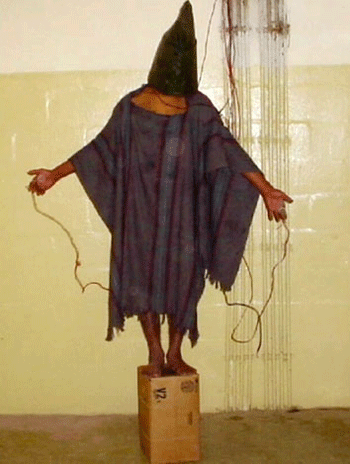
Abu Ghraib Prison was a military detention center in Iraq that gained public attention in 2004 due to human rights violations that occurred when United States military aggressively and inappropriately tortured prisoners.  These tortures included beatings, sexual abuse, and rape.  Photographs were taken of the various interrogations and torture sessions, which were then circulated to the public.  Two important questions arise: 1. How could US military personnel become so corrupt as to brutally torture detainees without reason, and 2. How did the American public react to these pictures? Psychology serves as a useful tool in dissecting both of these questions.

How did the public react to the events at Abu Ghraib? In Hauser’s piece, “Quo Vadis America: National Conscience in Framing Prisoner Bodies at Abu Ghraib” psychology fits in nicely with his assessment of the way in which the American public viewed the tortures at Abu Ghraib within the frame of war.  The photos from the torture sessions at Abu Ghraib called into question the moral implications of America’s leaders.  However, because the photos arose during a time of war, or, within the “frame” of war, American citizens turned a blind eye to Abu Ghraib.  The authors write: “The images of tortured prisoners of Abu Ghraib should, by all rights, haunt the American conscience.  But that conscience is so permeated with aggressive self-righteousness that there is no room for reflection or remorse.”

The corruption of US military personnel is an interesting comparison to Philip Zimbardo’s famous Stanford Prison Experiment that tested the psychology of evil, or, “The Lucifer Effect.”

In 1972, Phillip Zimbardo conducted a social psychology experiment in which he created a prison environment in order to understand prison life.  Zimbardo randomly separated participants into guards and prisoners.  The study ended after 6 days because of the extreme corruption which arose within the guard group.  The guards forced prisoners to do humiliating chores, stripped them naked, and forced them to perform degrading sexual activities.

Zimbardo points out 7 Social Processes help “grease the Slippery Slope of Evil,” describing how good apples can become bad apples:
1.     Mindlessly taking the first small step
2.     Dehumanization of others
3.     De-individuation of self (anonymity)
4.     Diffusion of personal responsibility
5.     Blind obedience to authority
6.     Uncritical conformity to group norms
7.     Passive tolerance of evil through inaction, or indifference

In the case of Abu Ghraib, we can see many of these steps being taken by the guards of the prison.  The guards dehumanized the prisoners, diffused responsibility among one another, and abided commands to torture by other officers.

Zimbardo describes the Lucifer effect as “individuals and groups who usually act humanely can sometimes act otherwise in certain circumstances” and argues that 
“If you give people power without oversight it’s a prescription for abuse.” There was little to no oversight at Abu Ghraib, which is a large reason as to why these atrocities were allowed to continue. 

It seems then, that oversight, though not a cure for evil acts, is an important element in disallowing these kinds of horrendous events to occur.  Therefore, prisons such as Guantanamo Bay and other military prison facilities should be tightly regulated, only allowing qualified military personnel to guard the prisons.  These measures, as well as implementing enhanced oversight, will help to lessen the amount this occurs. 

Though Zimbardo’s study acts as parallel to help understand the events at Abu Ghraib, psychologists aren’t immune to becoming corrupt themselves.  Gregg Bloche and JonathanMarks write about the use of confidential detainee health information at Guantanamo Bay prison to the advantage of interrogators.  According to the authors, “Since late 2002, psychiatrists and psychologists have been part of a strategy that employs extreme stress, combined with behavior-shaping rewards, to extract actionable intelligence from resistant captives.” In 2002, a Behavioral Science Consultation Team was created in order to make interrogation techniques more productive at Guantanamo.  Psychologists played a large role in creating techniques that would force detainees to give up information, using personal health information of the prisoners. Again, who is overseeing the legality of these actions?  

Though these situations paint a grim outlook on the way the United States treats military prisoners, it should act as a starting point to a revamping the system. The most important prescription is more emphasis on the military chain of command, and heightened oversight on all military related events.