Psychology is a useful tool when attempting to understand
interrogation and torture events in military prisons such as Guantanamo Bay and
Abu Ghraib. It can help explain both the
reasons behind the extreme torture at Abu Ghraib and the way in which the public
perceives such occurrences.
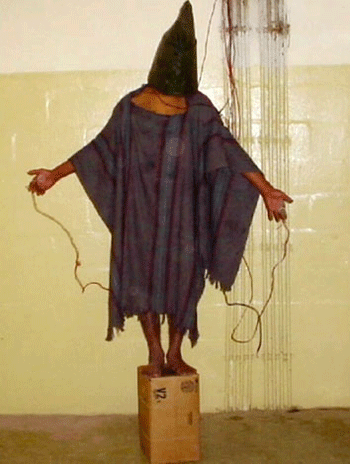
Abu Ghraib Prison was a military detention center in Iraq that
gained public attention in 2004 due to human rights violations that occurred
when United States military aggressively and inappropriately tortured
prisoners. These tortures included
beatings, sexual abuse, and rape.
Photographs were taken of the various interrogations and torture
sessions, which were then circulated to the public. Two important questions arise: 1. How could
US military personnel become so corrupt as to brutally torture detainees
without reason, and 2. How did the American public react to these pictures?
Psychology serves as a useful tool in dissecting both of these questions.
How did the public react to the events at Abu Ghraib? In
Hauser’s piece, “Quo Vadis America:
National Conscience in Framing Prisoner Bodies at Abu Ghraib” psychology fits
in nicely with his assessment of the way in which the American public viewed
the tortures at Abu Ghraib within the frame of war. The photos from the torture sessions at Abu
Ghraib called into question the moral implications of America’s leaders. However, because the photos arose during a
time of war, or, within the “frame” of war, American citizens turned a blind
eye to Abu Ghraib. The authors write:
“The images of tortured prisoners of Abu Ghraib should, by all rights, haunt
the American conscience. But that
conscience is so permeated with aggressive self-righteousness that there is no
room for reflection or remorse.”
The corruption of US military personnel is an interesting
comparison to Philip Zimbardo’s famous Stanford Prison Experiment that tested
the psychology of evil, or, “The Lucifer Effect.”
In 1972, Phillip Zimbardo conducted a social psychology
experiment in which he created a prison environment in order to understand prison
life. Zimbardo randomly separated
participants into guards and prisoners.
The study ended after 6 days because of the extreme corruption which
arose within the guard group. The guards
forced prisoners to do humiliating chores, stripped them naked, and forced them
to perform degrading sexual activities.
Zimbardo points out 7 Social Processes help “grease the
Slippery Slope of Evil,” describing how good apples can become bad apples:
1.
Mindlessly taking the first small step
2.
Dehumanization of others
3.
De-individuation of self (anonymity)
4.
Diffusion of personal responsibility
5.
Blind obedience to authority
6.
Uncritical conformity to group norms
7.
Passive tolerance of evil through inaction, or
indifference
In the case of Abu Ghraib, we can see many of these steps
being taken by the guards of the prison.
The guards dehumanized the prisoners, diffused responsibility among one
another, and abided commands to torture by other officers.
Zimbardo describes the Lucifer effect as “individuals and
groups who usually act humanely can sometimes act otherwise in certain
circumstances” and argues that
“If you give people power without oversight it’s a
prescription for abuse.” There was little to no oversight at Abu Ghraib, which
is a large reason as to why these atrocities were allowed to continue.
It seems then, that oversight, though not a cure for evil
acts, is an important element in disallowing these kinds of horrendous events
to occur. Therefore, prisons such as
Guantanamo Bay and other military prison facilities should be tightly
regulated, only allowing qualified military personnel to guard the
prisons. These measures, as well as implementing
enhanced oversight, will help to lessen the amount this occurs.
Though Zimbardo’s study acts as parallel to help understand
the events at Abu Ghraib, psychologists aren’t immune to becoming corrupt
themselves. Gregg Bloche and JonathanMarks write about the use of confidential detainee health information at
Guantanamo Bay prison to the advantage of interrogators. According to the authors, “Since late 2002,
psychiatrists and psychologists have been part of a strategy that employs
extreme stress, combined with behavior-shaping rewards, to extract actionable
intelligence from resistant captives.” In 2002, a Behavioral Science Consultation
Team was created in order to make interrogation techniques more productive at
Guantanamo. Psychologists played a large
role in creating techniques that would force detainees to give up information,
using personal health information of the prisoners. Again, who is overseeing
the legality of these actions?
Though these situations paint a grim outlook on the way the
United States treats military prisoners, it should act as a starting point to a
revamping the system. The most important prescription is more
emphasis on the military chain of command, and heightened oversight on all
military related events.


No comments:
Post a Comment